USA & Global


This is a case study. We are using one of our own Google Ads campaigns — ads for a marketing agency in Guayaquil — as the working example to communicate this topic. The point is not a polished client win. The point is to show what adding negative keywords actually looks like once a campaign is live, week after week.
A Google Ads campaign is not just the keyword. You set the ads, the audience, the landing, the location, the budget. Then you add words. Those words are supposed to decide when Google is allowed to show the ad. This campaign is built to appear when someone searches along the lines of agencia de marketing guayaquil.
Keywords come in three widths: exact, phrase, and broad.
Exact match is the one that looks responsible. You wrap the query in brackets — [agencia de marketing guayaquil] — and you tell Google: show the ad when someone searches this, or something so close it is the same intent. For a local service tied to a specific city, that feels like the adult choice.
Guess what happens. Google restricts the campaign. There are not enough searches, it says, for that exact keyword. The campaign sits there looking correctly configured and doing nothing. Exact match is not a strategy if the auction will not run.
So you open the match. Broad match is the other extreme. It is pointing at everything vaguely adjacent and hoping the algorithm has taste. It does not. Broad match on a phrase like "agencia marketing" is an invitation to pay for every educational, career, software, and "how do I start a business" query in the neighborhood of marketing.
Nobody who has watched a search-terms report for a week still believes broad match is a filter.
That leaves the middle width: phrase match. You would expect this to be the optimal setting. It is — but not as in "this is clean." It is optimal as in "this is the least-bad thing Google will let you run."
The product story is reasonable. Put "agencia marketing guayaquil" in phrase match and you should get close variants: grammatical conjugations, word-order shifts, obvious synonyms, the same buying question asked a slightly different way. You should not get a lecture on marketing theory. You should not get an AI ad tool. You should not get a motivational slogan.
Google is not a careful partner here. Phrase match still dumps the ad into searches that have nothing to do with the keyword.
Someone forgiving Google would say this only happens at the start — before any negatives exist, while the account is still empty and the algorithm is "learning." That is not what the report shows.
The capture below is from a campaign that had already been running for four months, with about five hundred negative keywords already in place. The keyword we are paying to interpret is still the Guayaquil agency query. Google still found room for 5 p del marketing and ad genius ai.
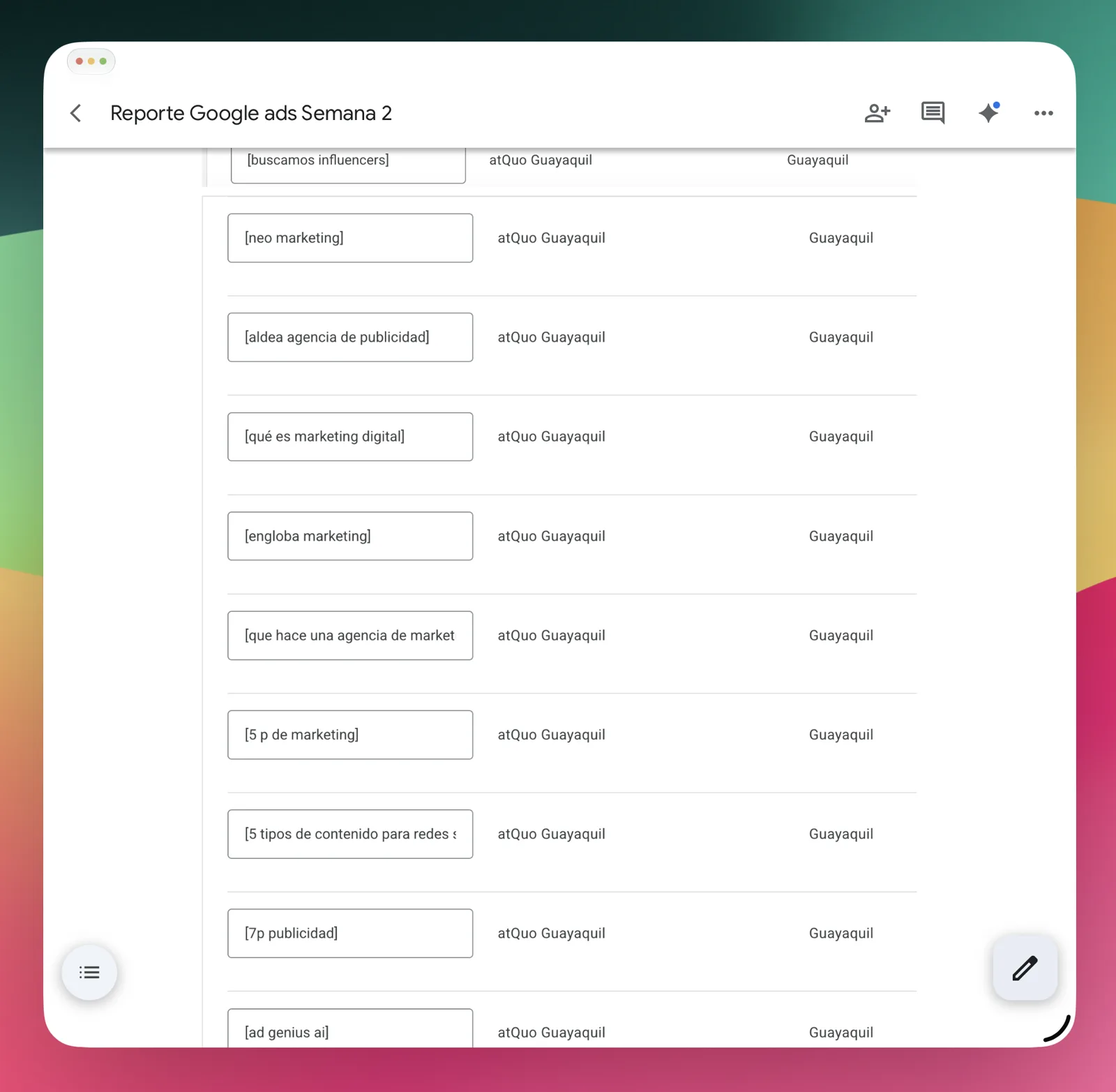
If phrase match meant what it sounds like, those queries would never have been eligible. They are not conjugations of "agencia de marketing guayaquil." They are not synonyms. They are not close variants. They are Google finding a way to spend the budget on something else.
Months later, after adding and adding negatives, new junk still appears. A later report includes searches like build your freedom — again treated as a reasonable variant of a local agency keyword.
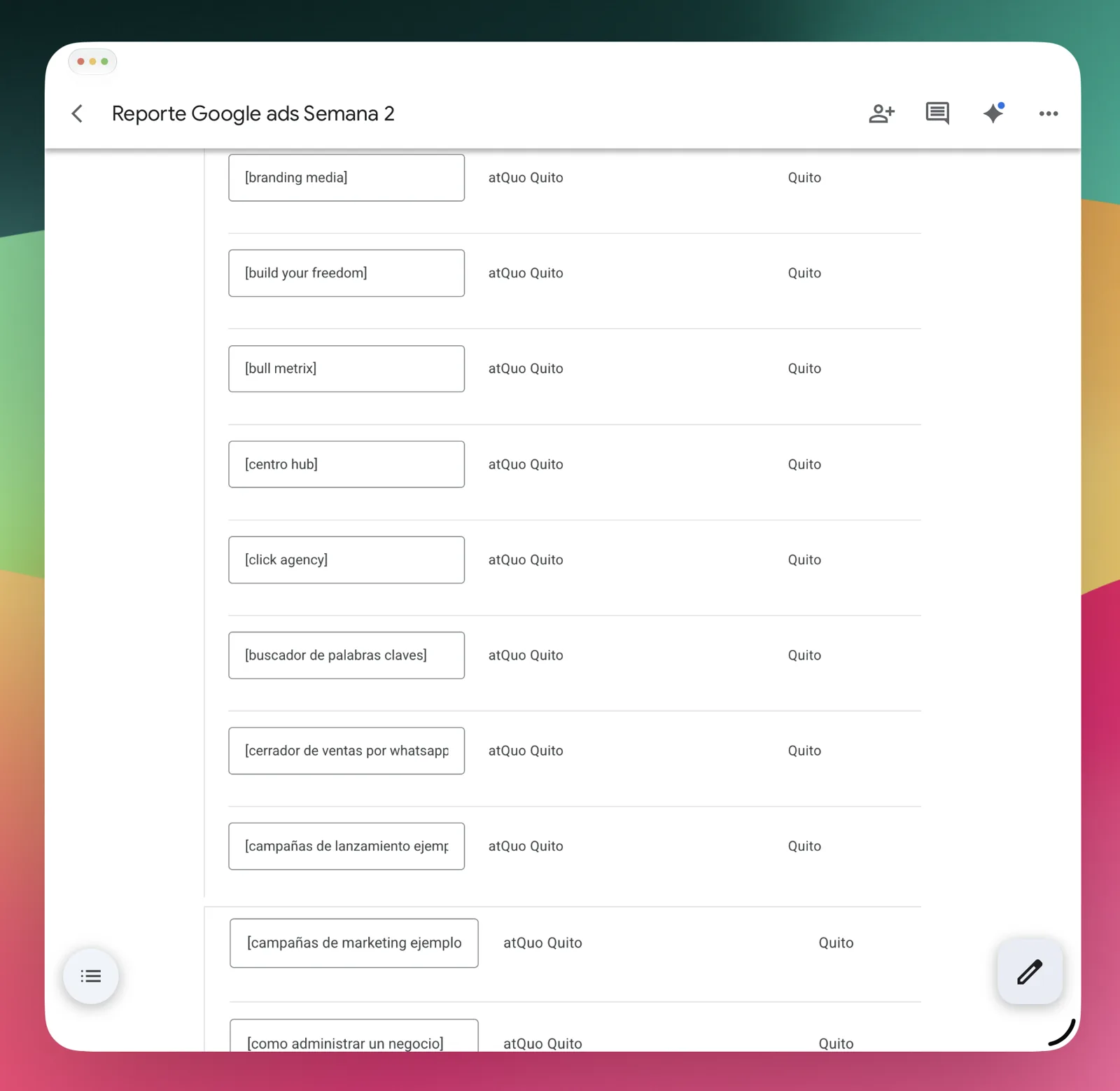
This is the pattern: you clean the search terms, conversions look saner for a while, and then a new family of nonsense shows up. The work is not a launch task. It is maintenance.
If we have a campaign, we want the ads to fire when people search for us the way we want to be found. In this example: agencia marketing guayaquil. We do not want to pay for clicks on nonsense like cómo levantar un negocio.
That last one is not a hypothetical. From day zero we added cómo se hace as a negative, hoping Google would stop treating how-to queries as a variant of hiring an agency. Four months later it still leaks through, now and then.
Negative keywords exist to say: do not show me as a variant of my keyword. This search is not purchase intent. Do not spend here.
When a stupid search appears, we mark that exact query as a negative exact match. Not a theme. Not a broad block that might also kill good traffic. The specific search that just wasted money.
Then we do it again the next week. And the week after that. For the life of the campaign. The search-terms report is not a dashboard you glance at. It is a cleanup list.
After months, the difference in conversions is visible — not because Google suddenly understood the keyword, but because we have filtered a pile of garbage that never had purchase intent. The campaign starts to look like the campaign we configured.
That is the whole job. Phrase match is the width you can actually run. Negative exacts are how you carve a real audience out of the mess Google keeps pouring back in. If you are not adding them every week, you are not running search. You are renting random traffic and calling it a keyword strategy.

Strategy, design, content and growth.